Archives
-
Proceedings of the 'Listening Pasts, Listening Futures' 2023 World Forum for Acoustic Ecology Conference
Vol. 1 No. 1 (2023)In March 23-26, 2023 The World Forum for Acoustic Ecology (WFAE) hosted its 30th anniversary with an international conference, “Listening Pasts - Listening Futures” at the Atlantic Centre for the Arts (New Smyrna Beach, Florida) located near the Canaveral National Seashore, in the unceded lands of the Seminole people. A global cohort of over one hundred artists, academics, authors, students and community engagement specialists gathered to present research, performances, installations and workshops considering how we may learn collectively from the past and imagine new futures based on a diversity of listening practices and acoustic relationships in our worlds. As the wider field of sound studies has matured, so have contributions made by acoustic ecology towards sonic scholarship and practice, including addressing the legacies of the World Soundscape Project. The convening of this community of international specialists to reflect on and re-imagine core values of the field, central approaches, methods, and key theorists of past, present, and future comes during a pivotal environmental awakening, when acoustic ecology and soundscape studies have much to offer the world. Keynotes at the conference included David George Haskell, scientist and internationally renowned author of 2013 Pulitzer finalist The Forest Unseen and most recently Sounds Wild and Broken; Claude Schryer, French-Canadian producer of conscient podcast; Amanda Gutiérrez, Mexican artist/academic; and Jacek Smolicki, ACA 2023 Artist in Residence.
As these proceedings demonstrate, acoustic ecology has matured and moved in critical and prescient directions along with new diversities of voices in the field. Some of the common themes to emerge from this historic edition of the WFAE conference include:
- An attention to the ethics of field recording: how to proceed in ways that are not extractivist of nature; how to be a guest within soundscape ecologies; how to seek forms of collaboration and consent from non-human inhabitants
- An infusion of feminist and queer methodology frameworks in thinking about place, sound and listening: what does it mean to listen with positionality; how does our listening practice “construct” places and soundscapes?
- New evaluative frameworks for dealing with ecologically-threatening noise; how can the study of acoustic ecology and longitudinal data in noise pollution help protect habitats?
- Pedagogical innovations in teaching with sound and fostering listening practices; toolkits and guidelines for classroom activities, organised actions, youth programs, and links to environmental initiatives.
Along with critical perspectives on sound, participants this year dealt with themes of feminist kinship, decolonization, and radical art practices. Both the scholarship, and the calibre of critical art-based interventions speaks highly of the next generation acoustic ecologists. Enjoy reading!
Milena Droumeva and Lindsey french
Conference Proceedings Co-Editors -
Sound + Environment: Sonic Explorations
Vol. 18 No. 1 (2019)Volume 18 brings together research from the WFAE’s UK and Ireland Soundscape Community (UKISC) affiliate with guest editor Dr Rob Mackay, an award-winning composer, sound artist and performer who works in a highly interdisciplinary context. This edition highlights selected papers from ‘Sound + Environment 2017’ – a conference hosted at the University of Hull that brought together artists and scientists to explore the ways that sound can deepen our understanding of environments.
- Guest Editorial, Rob Mackay
- Sounding Soil: An Acoustic, Ecological & Artistic Investigation of Soil Life, Marcus Maeder, Martin M. Gossner, Armin Keller and Martin Neukom
- go your gait! Artistic Research on Walking & Listening, katrinem
- Biosphere Open Microphones (BIOM) – Towards a network of remote listening points in the UNESCO Biosphere Reserves, Soundcamp: Maria Papadomanolaki, Dawn Scarfe, Grant Smith
- Listening In / Listening Out: Reflections on A Certain Geography Workshop Held at the University of Hull, Maria Papadomanolaki
- An Uncomfortable Audio Ethnography – Sound and Politics in the Evolution of an Acouscenic Listening Approach to Softday’s Sonically Engaged Art Practice, Mikael Fernström and Sean Taylor
- Guest Editorial, Rob Mackay
-
Celebrating 20 Years of the Australian Forum for Acoustic Ecology
Vol. 17 No. 1 (2018)Volume 17 celebrates the 20th anniversary of the Australian Forum for Acoustic Ecology and profiles the incredible diversity of acoustic ecology practice and research happening across Australia. The three feature articles showcase established Australian practitioners who are pushing the boundaries of sound and interrogating our sonic relationship with place. Volume 17 is dedicated to AFAE founder Nigel Frayne and features a tribute to his life and work from Hildegard Westerkamp.- Editorial, Leah Barclay
- Listening Invocation, Vicki Saunders and Gayle Munn
- Remembering Nigel Frayne, Hildegard Westerkamp
- The Acoustic Sanctuary, Ros Bandt
- Intersecting Place, Environment, Sound, and Music, Vanessa Tomlinson
- The Sound of Place: Environmental Artworks at Bundanon, Nigel Helyer and John Potts
- Earthscape Review, Melinda Barrie
- RMIT Gallery Chaos & Order: Sonic Arts Collection Review, Melinda Barrie
- Listening to Country: Exploring the value of acoustic ecology with Aboriginal and Torres Strait Islander women in prison, Sarah Woodland, Vicki Saunders, Bianca Beetson, Leah Barclay
- Emerging Researcher Profile, Jesse Budel
- Field Report: Sonic Mmabolela 2017, South Africa, Vicki Hallett
-
Sounds Emergent: Diverse Ecologies Part II
Vol. 16 No. 1 (2017)To resound on the insightful and varied career of 20th century composer and improviser Pauline Oliveros, is to think ecologically. Understanding the breadth of her musical, spiritual and communicative legacies requires us to extend our figurative margins and dream in volumes of thought and volumes of sound. This good work is ongoing and while some of Deep Listening’s life lessons and profound ideas are traced within this continuation of the Sounds Emergent thematic, it is designed as an overture to help chronicle aspects of her influence and to make evident an often unexplored but wonderfully nuanced kinship to Acoustic Ecology. It is my hope that the collective works in this edition serve to inspire and that those who might not be familiar with her work, now have several new reference points that are rich in detail and insight. Our authors have added to an already resonant ecology of words surrounding the important work of Pauline Oliveros and we are proud to present them here. – Jay Needham
-
Sounds Emergent: Diverse Ecologies
Vol. 15 No. 1 (2016)Sounds Emergent: Diverse Ecologies is a small measure within a continuing historical record, a core sample taken from the global art and science dialog when we collectively arrived at another eco-critical turn and shift towards urgent action. The messages in this edition of Soundscape: The Journal of Acoustic Ecology forecast the need for our species to shift our perceptive modalities, to be intersubjective. It is the Holocene and our epoch of time is about the whole of everything. An ecology of everything might bend the sound barrier in a way that suggests our work might not depart or arrive from any singular point of audition. This implies that art and science collaborations are fuzzy places where both ideas and disciplines burrow and uplift, zones where science, arts and polity toil, a brackish place of continual change.
-
Canacoustica: Canadian Perspectives on Environment and Sound
Vol. 14 No. 1 (2015)This winter and spring are like no other. In the far north, the silence of missing icebergs, groans and creaks of tardy ice fields, and the reverberation of glacier walls sheering disrupt ancient requisites in startling ways. In the east, winter borrows its lost measure from the north – deep freeze and deep snow relentlessly. In the west, winter is a whisper and early summer coddles early spring. The south creeps steadily northward. In this instability, sound ecology’s diverse local and global concentrations herald extraordinary planetary alteration. In rural and urban soundscapes, we listen and wonder at what was, what is, and what is coming – to how we are shaped as planetary beings, acoustic ecologists, researchers, artists and thinkers in our uniquely local sensibilities and global iterations. Synergies and discourses emerge that are like unanticipated winds and divergent ocean currents, like weather and seasons in flux.
Likewise, the Canadian Association of Sound Ecology (CASE) board members from different regions, backgrounds, and concentrations across this expansive terrain come together to share their thinking and work in acoustic ecology for this issue of Soundscape. The lineages from which these works derive are not limited to Canada, but are nevertheless innate to the now global fascination with acoustic ecology and all its practises. Initially, the symposium’s aim was to collect articles on sound and the environment, but unanticipated conversations emerge among articles that can be construed as a collective ethos. Within this ethos, listening clusters around mapping, phenomenological, nature and community-driven methodologies. Consistently, listener-to soundscape edification interrogates these methodologies and opens them to the imperative of lived experience – which finds different means of expression such as artistic and musical compositions, poetics and invocations, gatherings, serendipitous encounters with others and ever-present self-sentience.
-
Music and ecologies of sound: Theoretical & practical projects for a listening of the world
Vol. 13 No. 1 (2014)In recent music as well as in sound art, sound has emerged as a crossroad of theoretical and practical questions. Many of these questions concern the permanent interaction of sound with what surrounds it: physical space, environment, the audience. Instead of taking sound as a reified entity and using it as mere material at their disposal, musicians and sound artists began to consider it more carefully, and to view it as a fragile entity, which exists only through this interaction. In this view, we can speak about an ecology of sound. “Ecology” means here, the way of thinking which views oikos, i.e. the common home, our world, as a set of relationships rather than separated objects. The French psychoanalyst and philosopher Félix Guattari (1989) designates three ecologies: environmental, social and mental. Thus, we could say that, through the ecology of sound, musicians or sound artists explore the way sound appears, develops and disappears through its interaction with nature, society and human subjectivity, inviting the active listener to reconstruct his own interaction with the world.
The feature articles printed in this issue of Soundscape were presented as papers in a symposium, which tried to promote this idea of the ecology of sound. Entitled Music and Ecologies of Sound; Theoretical and Practical Projects for a Listening of the World, this symposium wished “to give priority to the analysis of practices and theories, which aim not only to develop our knowledge of the interactions between sound (music), the environment, society and subjectivity, but also to think about the possibility of changing the world for the better”. Organized by the University Paris 8 (France) in May 2013, it gathered many artists and scholars from various countries. We choose here five papers to illustrate the plurality of the approaches that were developed during this symposium.
-
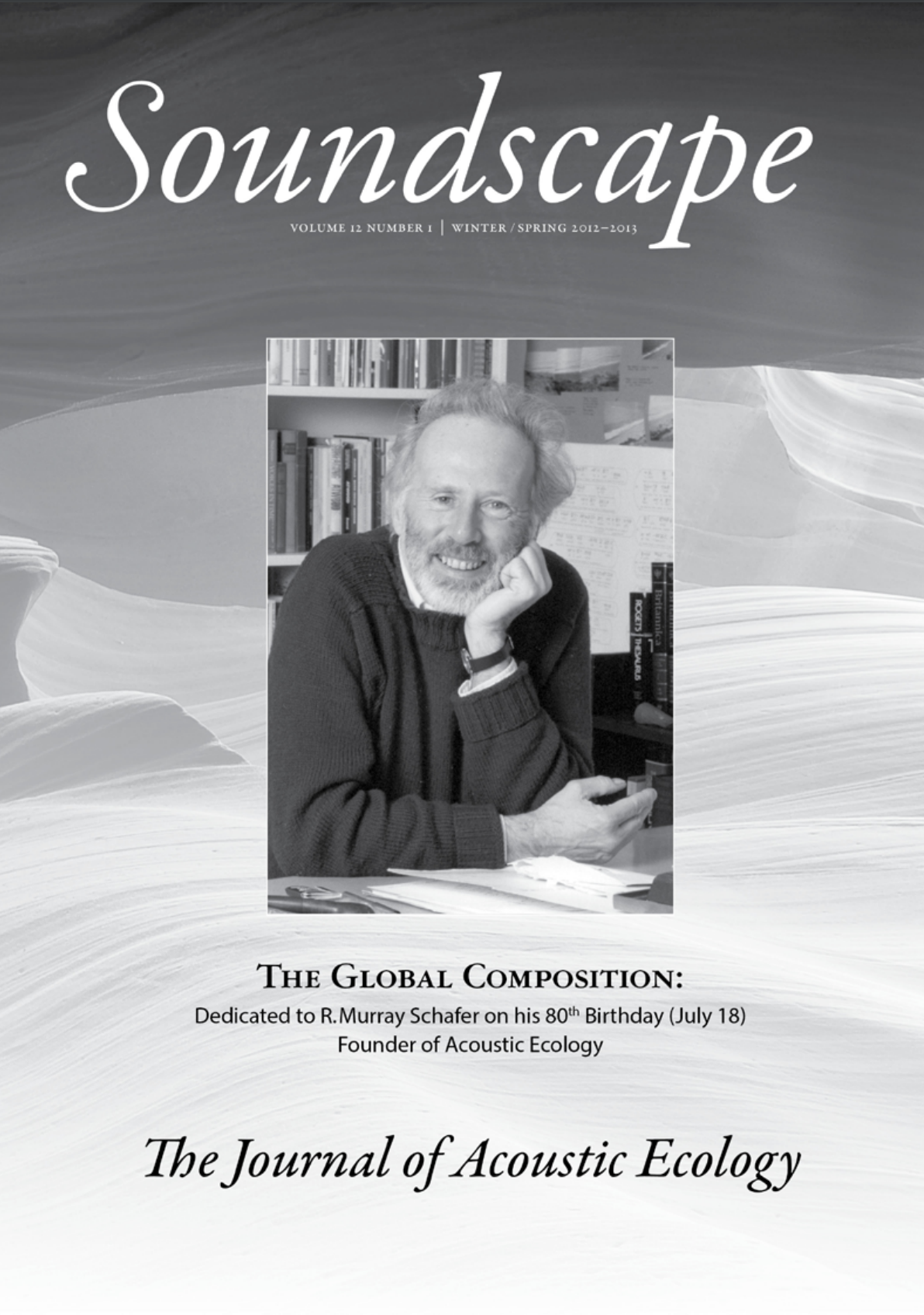
The Global Composition
Vol. 12 No. 1 (2013)This issue of Soundscape: The Global Composition, arrives at a pivotal time in the history of Acoustic Ecology. This Soundscape presents and expounds on research and creative projects that grew out of “The Global Composition: Sound, Media, and the Environment” conference in July 2012.
-
Crossing Listening Paths
Vol. 11 No. 1 (2011)From the World Soundscape Project in Vancouver in the late 1960s to the founding of the World Forum for Acoustic Ecology in 1993, to an expanding Acoustic Ecology movement in the 2010’s… An experimental ecological sound based movement introduced by R. Murray Schafer about half a century ago, today has spread in time and space reaching a stage of maturity associated with an emerging tendency for self-reflection and re-examination of its identity. Its strong association with art, science, and community makes it especially prone to the multiple and profound changes introduced in the above areas since its emergence.
The WFAE 2011 Conference in Corfu Greece with its theme: “Crossing Listening Paths” attempted to address the issue of the current identity of Acoustic Ecology in the context of artistic, scientific and societal changes, as they have been reflected in the field’s actions globally. In an age of complexity, globalization and overspecialization, basic questions about Acoustic Ecology’s identity that appeared worth pondering were:
- What are the “listening paths” taken or invented by acoustic ecology researchers and artists?
- To what extent are there crossovers within and between research and artistic approaches, methodologies, terminology etc?
- Is there an overarching philosophy? Are there overarching values and ethics?
- Is there really a common code or does every researcher/artist/activist address the imbalances in the acoustic environment from his/her own professional and personal perspectives?The current issue of Soundscape is coming as a complement to the WFAE 2011 Conference, to highlight issues of identity and crossroads in Acoustic Ecology.
-
Sonic Ambiances
Vol. 10 No. 1 (2010)The feature articles of this issue all explore the richness of ambiance and its complex relationship with space, place, time and urbanity.
-
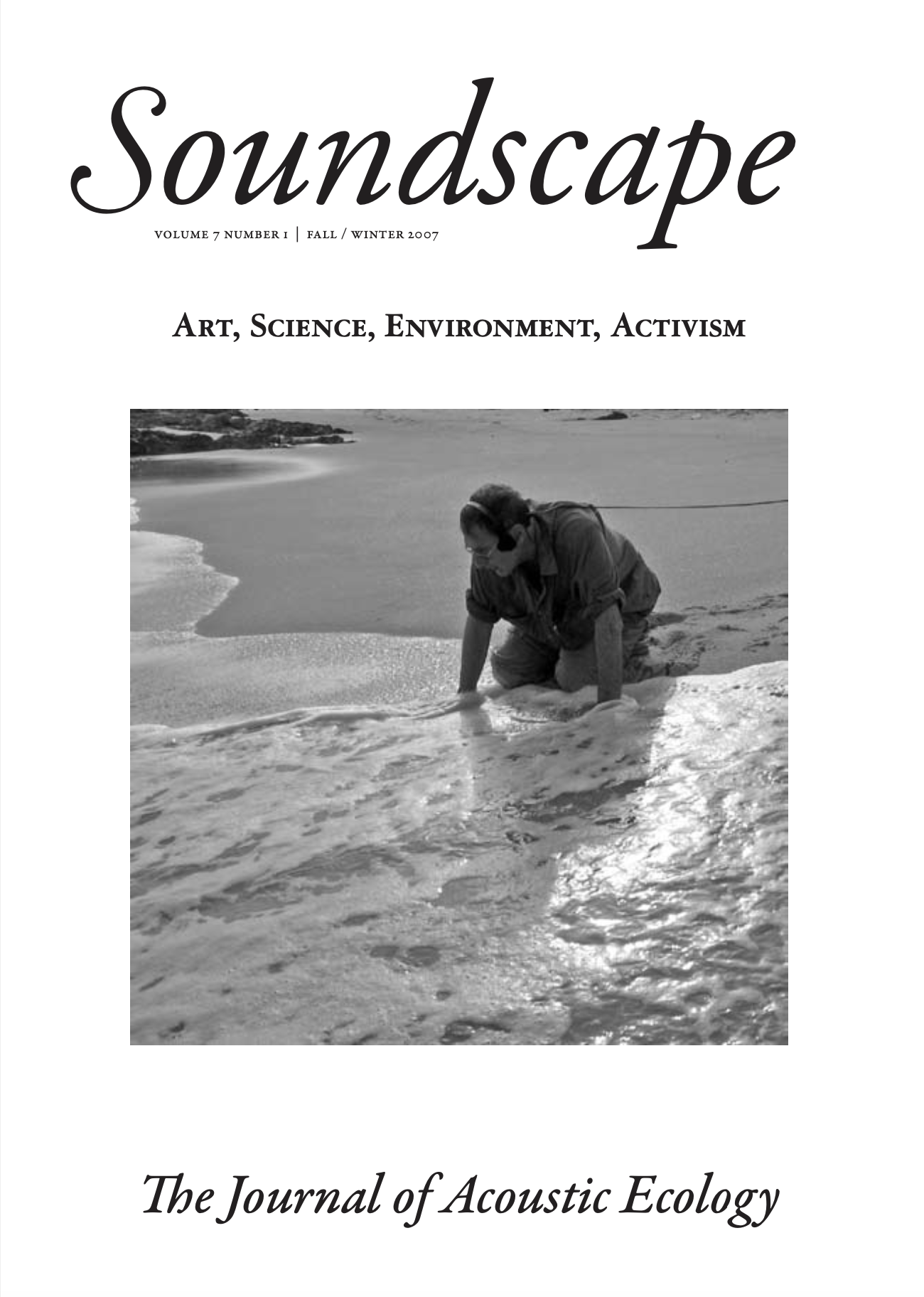
Art, Science, Environment, Activism
Vol. 7 No. 1 (2007)In this issue, we feature project reports on three sound art projects whose activism was oriented toward engaging local people with their own local soundscapes, explicitly encouraging deeper connection with the place through sound. As you’ll read, the implicit layer of fostering protection for the soundscapes or habitats varies among the projects, being strongest in the Icelandic and Panamanian projects, while Annea Lockwood’s Danube Sound Map is more an exercise in encouraging listening to place and acknowledging historical reso- nances that remain audible.
-
Soundscape Studies In Japan
Vol. 6 No. 2 (2005)In the context of the upcoming WFAE 2006 International Conference on Acoustic Ecology in Hirosaki, Japan, November 2—6, 2006, it is with great pleasure that we are presenting you with an issue of Soundscape whose focus is on Japan. We present you with three important articles from Japan, which in our opinion are representative of numerous other examples of soundscape activities, thought and philosophy in this country.
-
Hearing Loss
Vol. 6 No. 1 (2005)This issue explores features of the auditory system and tools for a lifetime of listening, or if hearing has become impaired, devices for hearing assistance. The feature articles discuss the use of hearing protection as a defense against noise-induced hearing loss and a means of reducing annoyance, the mechanics of audition and how sounds affect our ear, tinnitus (noise in our ears in the absence of actual sound) and its causes and treatment, and remediation of those effects via hearing aids for those who fail to protect themselves or who lose hearing from other causes. Additionally this issue includes personal experiences of hearing loss and sound excess in the Perspectives section, as well as reports of conferences with WFAE involvement, reviews of books and CDs, and other contributions that explore various aspects of the soundscape.
-
The Experience of Music in Daily Life
Vol. 5 No. 2 (2004)What is your experience of music in daily life? When and in which situations do you encounter music? How much of it is live, how much of it broadcast over loudspeakers? How often do you put on music with the intent to listen, how often in order to create a background ambience? When and how often do you make your own music, by yourself or with other musicians? How often do you turn music off, and stop to listen? Do you encounter situations in daily life in which you perceive music, but where others only hear random sound—where the boundary between what is understood as music and what is perceived as sound becomes blurred?
-
Acoustic Design
Vol. 5 No. 1 (2004)In this issue of Soundscape we present four feature articles, three current research projects, a sound journal and more, all dealing with some aspects of acoustic design. They offer a spectrum of current activities in this field as applied to urban environments, public buildings, parks and indoor places.
-
..acoustic ecology... an international symposium, Melbourne, Australia
Vol. 4 No. 2 (2003)This issue of Soundscape has been created around the International Symposium on Acoustic Ecology in Melbourne, Australia, March 19—23, 2003. Nigel Frayne’s reports on pp 4-5 will give you a first-hand account of how the symposium came about and what was involved in organising it. In Perspectives you will find two reports by participants Paul Howard and Gordon Monro (pp. 37- 39), whose differing ways of writing about the event make for interesting reading. Also in Perspectives, Helen Dilkes reports on Murray Schafer’s ear cleaning work with Melbourne school children and its subsequent presentation at the symposium (p. 44). And Lawrence Harvey reports about a new education and research program at RMIT University in Melbourne, which investigates the aural dimensions of architectural teaching, practice, and design, as well as composition and listening.
-
Blind Listening
Vol. 2 No. 1 (2001)Welcome to the third issue of Soundscape. Our theme of blind listening is one that explores the many possible dimensions of aural perception beyond vision-assisted hearing.
-
Silence, Noise and The Public Domain
Vol. 1 No. 2 (2000)This issue focuses on the soundscape as a public domain—as the commons—which in the social sense, has come to mean shared public spaces, not just publicly owned parks, or squares. The commons in the ecological sense has come to mean the larger natural environment upon which we all depend. The former is a subset of the latter.
-
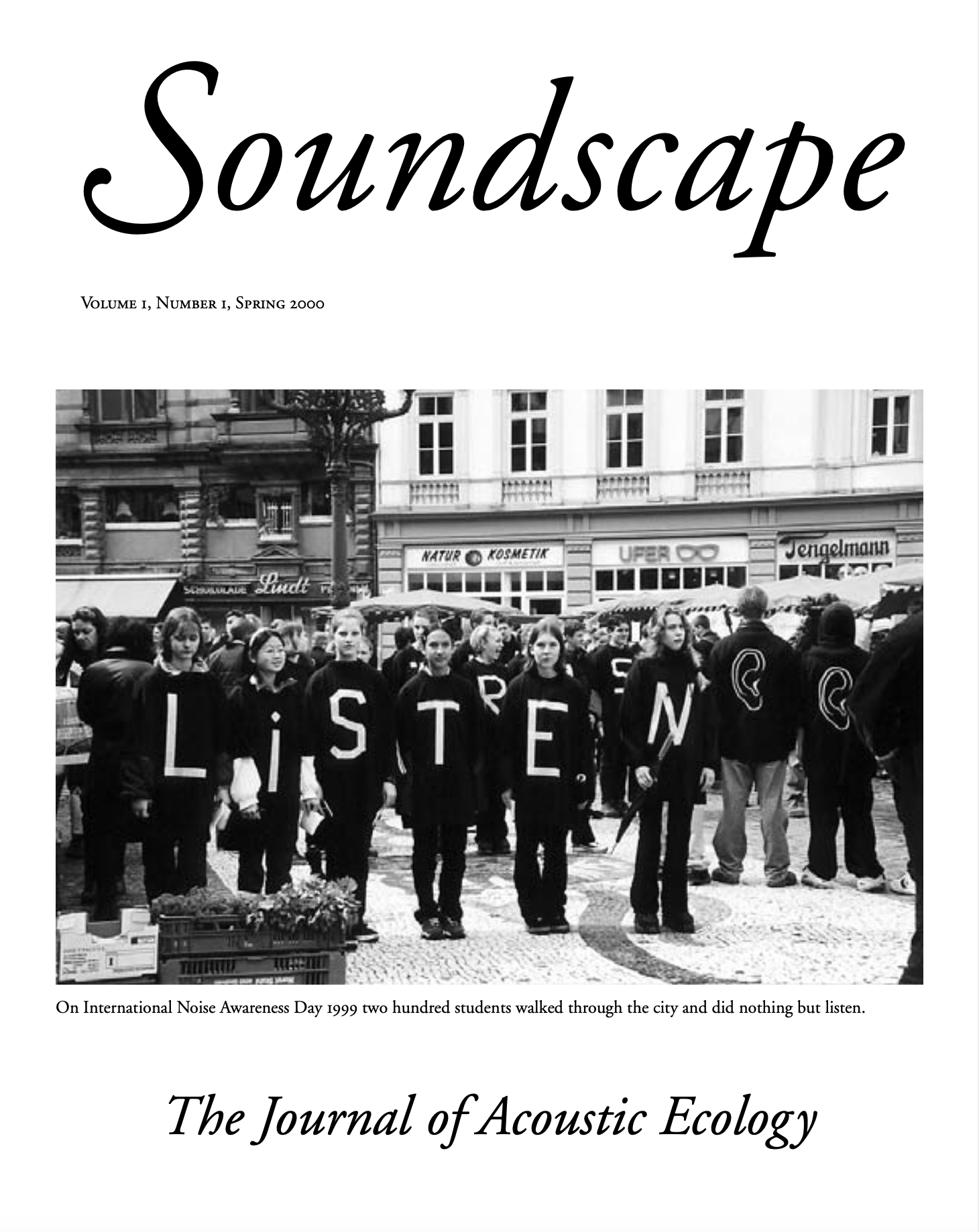
Listening
Vol. 1 No. 1 (2000)We are excited to present to you the first issue of Soundscape—The Journal of Acoustic Ecology. Af- ter having had to work hard in the last few years to establish a better-functioning network through the World Forum for Acoustic Ecology (WFAE), we now want to devote more time to the theme of acoustic ecology. So far The Soundscape Newsletter, The New Soundscape Newsletter, and our website have been instrumental in keeping the acoustic ecology community connected and in-formed. But now we feel it is time that we pool our energies through this new publication and disseminate more and new vital information about the state of the acoustic environment and acoustic ecology. We see this journal as a place of dialogue and debate and invite your comments, questions and critical voices.
We have made Listening the theme of this first issue of Soundscape, because listening forms the basis for all work in acoustic ecology. Without knowing what enters our ears and without understanding the environmental, social, cultural and personal implications of this input, there can be no study of acoustic ecology. Daily practice of listen- ing develops in each one of us a conscious physical, emotional, and mental relationship to the environment. And to understand this relationship is, in itself, an essential tool for the study of the soundscape and provides important motivation for engaging with to- day’s acoustic ecology issues—no matter whether the context is our personal or our professional life. In addition, listening creates the much-needed continuity in an otherwise fragmented field of study or area of environmental concern. In the same way, the theme of listening connects (so we hope) the diverse articles in this issue of the journal, written by people from very different professions and areas of action.